


Perspectives On Air Power - Air Power In Its Wider Context
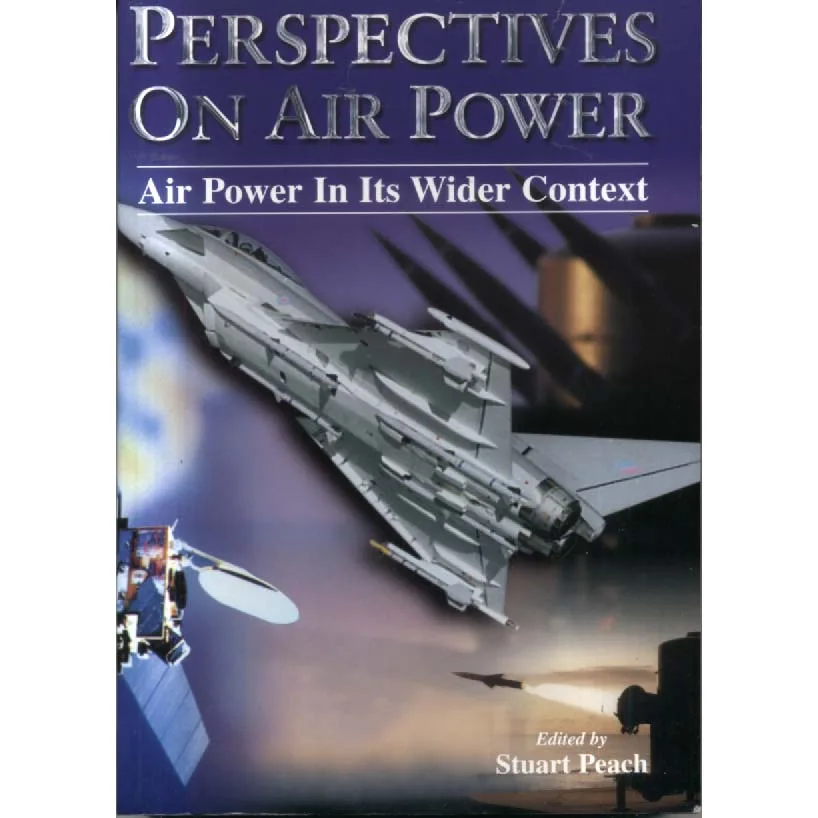
Publisher: The Stationery Office
Format: Paperback
ISBN: 9780117728882
Small correction for the listing: Perspectives on Air Power is edited by Stuart Peach, with chapters contributed by a range of military officers, historians and defence specialists. It is not a single-author work written entirely by him.
Air power is often discussed as though aircraft operate inside a convenient blue compartment labelled “war,” untouched by politics, economics, industry, public opinion or the other armed services. Perspectives on Air Power: Air Power in Its Wider Context opens that compartment and allows all the neglected complications to enter at once.
Edited by RAF officer Stuart Peach, this substantial collection examines aviation not merely as a selection of aircraft and weapons but as an instrument of national power. It asks how air forces are shaped by governments, technology, alliances, industrial capacity, strategic culture and the societies that must pay for them. An aircraft may fly independently; an air force requires practically everybody else.
Published in 1998, the book emerged during the uncertain decade after the Cold War. The Soviet threat that had organised Western defence planning for generations had disappeared, but peace had inconsiderately failed to become universal. The Gulf War, Bosnia and other crises suggested new roles for air power in coalition warfare, intervention and peace-support operations, while governments eagerly anticipated a substantial “peace dividend” from budgets already promised elsewhere.
The contributors consider the political context in which air forces operate. Military planners may calculate targets, sortie rates and weapons effects, but elected governments decide what the operation is intended to achieve—or occasionally decide that after the operation has begun. Air power can deliver force rapidly, yet it cannot force political objectives to become coherent merely by arriving on time.
The book examines threats and challenges within the changing international environment. With large conventional war appearing less likely, Western forces faced regional instability, failed states, ethnic conflict and humanitarian emergencies. These situations required military power capable of precision and restraint, two qualities that appear perfectly compatible until intelligence is incomplete and the target is located beside a television crew.
Civil-military relations also form part of the wider picture. Air forces require public support, political legitimacy and confidence that specialists operating complex weapons remain accountable to civilian authority. The people who understand the machinery may not control the policy, while the people controlling the policy may require a briefing to distinguish a sortie from an aircraft. Democracy proceeds through such cooperative arrangements.
Technology receives proper attention, but not as an independent force descending from the laboratory to solve strategy. Stealth, precision-guided weapons, surveillance systems and information networks transformed what air forces could attempt. They did not abolish weather, mechanical failure, human error or the enemy’s ability to adapt. Every revolutionary technology remains revolutionary until the opposition obtains the instruction manual.
The contributors place air power within its economic and industrial setting. Advanced aircraft require years of development, specialised manufacturers, trained personnel and extraordinary sums of money. Governments must decide what threats will exist decades in the future and then order equipment for them in advance. Defence procurement is therefore a form of heavily armed fortune-telling conducted through committees.
Space and information systems broaden the definition of air power beyond aircraft. Satellites support navigation, communications, reconnaissance and targeting, making operations increasingly dependent upon assets orbiting far above the battlefield. The pilot may remain the visible heroic figure, but invisible networks now explain where to fly, what to strike and whether the heroic figure has sufficient fuel to return.
The final part turns to air power in its specifically military context. Philip Sabin examines its role in joint warfare, where aircraft must work alongside armies and navies whose officers have developed their own traditions, terminology and opinions concerning who is supporting whom. Joint operations are essential because modern war is complex; they are difficult because military services have spent generations becoming independently complex.
Air power’s coercive potential is another important theme. Bombing may destroy an opponent’s forces and infrastructure, but coercion aims to change behaviour: to make leaders stop, withdraw or negotiate. This requires understanding what the opponent values and what pressure will influence his decisions. Dropping more bombs is an activity; achieving the desired political response is an outcome, and the two have occasionally been introduced only briefly.
The collection also considers air power across the spectrum of conflict, from deterrence and conventional war to peace support and intervention. Aircraft can monitor territory, transport troops and aid, enforce exclusion zones, gather intelligence and deliver precision attack. They can be both independent instruments and vital enablers of other forces, which gives everyone sufficient grounds to claim that their own contribution was decisive.
Stuart Peach’s introduction brings these subjects together into a broad view of air and space power. At the time, Peach was an experienced Tornado navigator, weapons instructor and former squadron commander engaged in RAF defence studies. He would later rise to become Chief of the Defence Staff and chair NATO’s Military Committee, suggesting that his interest in the wider context was not entirely wasted.
This is not a glossy aircraft book or a sequence of combat narratives. It is a serious collection about strategy, policy, technology and military institutions, written for readers who wish to understand why possessing capable aircraft does not automatically produce sensible results. The flying is sometimes the straightforward part; agreeing upon the purpose may require the remainder of the volume.
Some essays inevitably reflect the strategic assumptions of the late 1990s, which is now part of their value. They capture a moment when precision weapons, information warfare and Western expeditionary operations appeared to promise a new model of conflict. Subsequent history supplied revisions, as history generally does after doctrine has gone to print.
This book will appeal to readers interested in the RAF, defence policy, military aviation, strategic studies and post-Cold War warfare. Its multiple contributors offer genuinely different perspectives, demonstrating that even air-power specialists cannot agree on air power without first deciding which wider context they have in mind.
This copy is in Good condition, showing ordinary signs of previous ownership but remaining fully capable of supporting another strategic review. Offered by Crappy Old Books, it is a thoughtful examination of air power beyond the cockpit—where aircraft meet politics, budgets, alliances and the immovable object known as inter-service cooperation.
Keep browsing: See more War books Other books by Stuart Peach
